📚 Lists & Loops
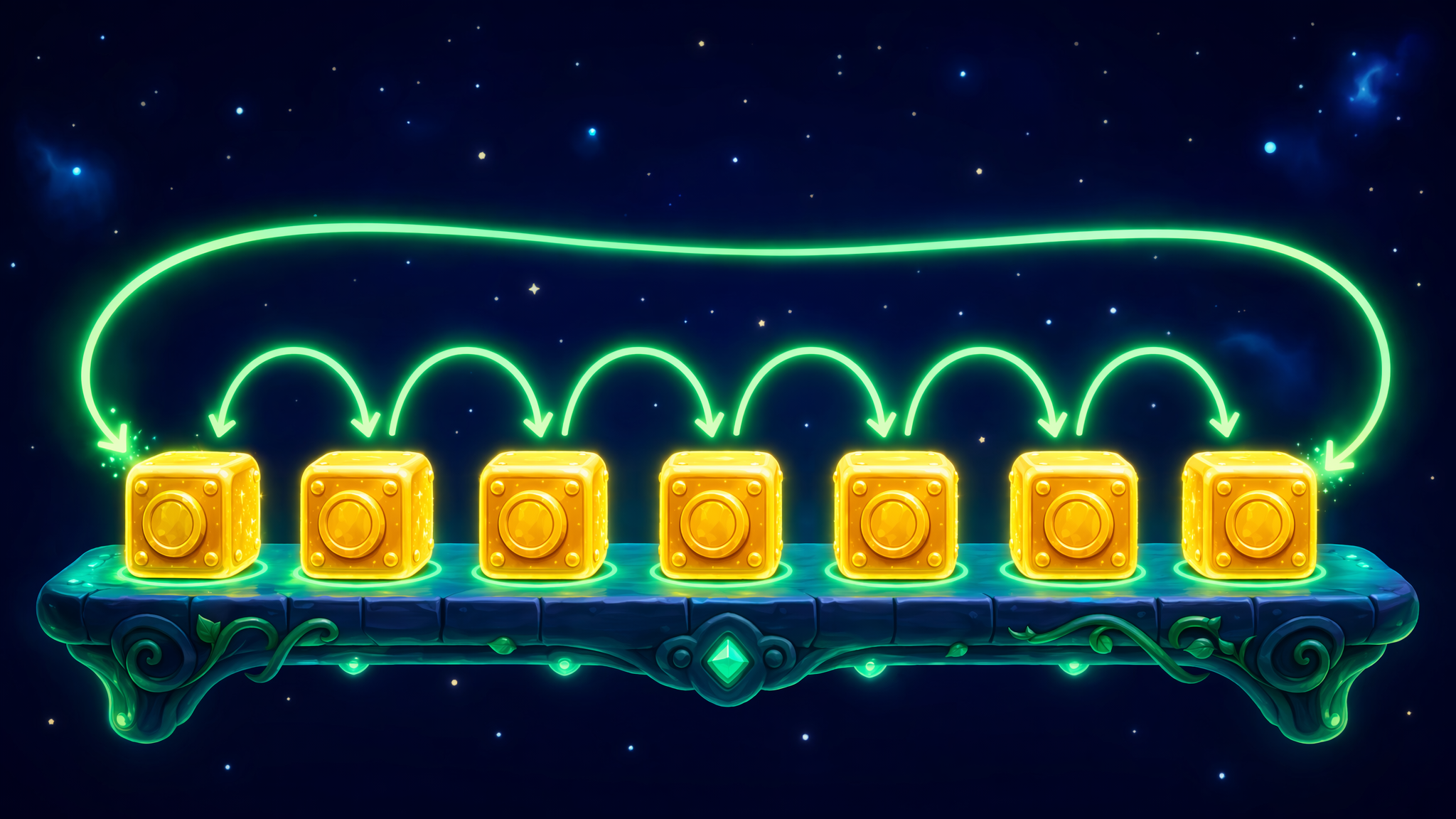
Say you had 100 coins to collect. You would notwrite “collect coin 1, collect coin 2, collect coin 3…” a hundred times — that's bananas. 🍌 There's a much smarter way.
Put all the coins in a list, then use a loop to run one rule on every single one.
The big idea: one rule, the whole list
A list is just a row of boxes that holds a bunch of things — all your coins, all your enemies, all the blocks in a level. Instead of a separate name for each, they live together in one list.
A loop is how you deal with the whole list at once: “for eachthing in the list, do this.” You write the rule a single time, and the loop runs it on every item — 3 of them or 3 million. That's how one tiny bit of code can move a thousand stars or check a whole world.
Your turn: run a rule down a list
Watch the glowing cursor — that's the loop — walk the list and do the job to each coin. Make the list longer, switch the job, and notice you never have to write a second rule.
One rule, written once — the loop runs it on every coin, however many there are.
📏 How long is the list?
🔧 The job
⚡ Loop speed
Discovery missions
Try each one, tick it off, then peek at the secret.
👀Run the loop with 5 coins and watch the glowing cursor. What does it do at each coin?
📏Slide the list up to 12 coins and run it again. Did you have to add any new rules for the extra coins?
🌈Switch the job to Paint and run. The job changed — but did the loop change?
🤯Imagine the list had ONE THOUSAND coins. How much more code would you write?
🪙Remember collecting coins in your game. How do you think it checked all of them?
🌟 New thinking tool unlocked! You now know:
- 📚 A list is a row of boxes that holds many things.
- 🔁 A loop visits each item and runs the same rule on it.
- ✍️ You write the rule ONCE — it works for 3 items or 3,000.
- 🧩 The loop and the job are separate — mix and match them.
- 🪙 Your game's coins were a list it looped over every frame.